
ByteDance’s Lynx: A Comprehensive Analysis of the New Cross-Platform Framework
On This Page
Executive Summary / TL;DR
Launched on March 5, 2025, Lynx combines web development paradigms with native performance, targeting developers seeking to build high-performance applications for Android, iOS, and the web using a single codebase.
Key Takeaways
- Lynx uses a dual-thread architecture separating UI rendering (PrimJS/QuickJS) from business logic for native-like performance.
- Instant First-Frame Rendering eliminates startup blank screens by blocking main thread until initial UI renders.
- Rust-based toolchain (RS Pack) enables fast compilation and memory-safe builds.
- Framework-agnostic design allows use with React, Vue, or other frameworks unlike React Native's React coupling.
- Main Thread Scripting schedules critical interactions directly on UI thread for native responsiveness.
ByteDance, the technology conglomerate behind TikTok, has introduced Lynx, an open-source cross-platform framework designed to redefine mobile app development. Launched on March 5, 2025, Lynx combines web development paradigms with native performance, targeting developers seeking to build high-performance applications for Android, iOS, and the web using a single codebase. This article examines Lynx’s architecture, technical innovations, and competitive positioning against established frameworks like React Native, while addressing its implications for the future of cross-platform development.
- ByteDance’s Lynx: A Comprehensive Analysis of the New Cross-Platform Framework
- Lynx vs. React Native: Performance Implications and Benchmarking
- Lynx vs. Kotlin Multiplatform: A Comprehensive Performance Benchmark Analysis
Architectural Foundations of Lynx
Dual-Thread Execution Model
Lynx’s most distinctive feature is its dual-thread architecture, which separates user code execution from UI rendering to optimize performance. The framework splits JavaScript workloads into two independent runtimes:
- Main UI Thread: Powered by the PrimJS engine (a lightweight JavaScript runtime built on QuickJS), this thread handles high-priority tasks such as UI updates, touch events, and animations. By dedicating this thread exclusively to rendering, Lynx ensures smooth interactions even under heavy computational loads.
- Background Thread: Manages business logic, data fetching, and state management. This separation prevents blocking the main thread, enabling features like Instant First-Frame Rendering (IFR), which eliminates blank screens during app startup by briefly blocking the main thread until the initial UI is fully rendered.
The dual-thread model is complemented by Main Thread Scripting (MTS), a mechanism that schedules critical interaction code (e.g., gesture handling) to run directly on the main thread, mimicking native app responsiveness.
Rust-Based Toolchain
Lynx leverages Rust for its build system and module bundler (RS Pack), ensuring fast compilation and reduced memory overhead. This choice aligns with industry trends toward memory-safe languages, particularly for performance-critical tooling.
Framework Agnosticism
Unlike React Native, which is tightly coupled with React, Lynx is framework-agnostic. While it ships with ReactLynx (a React-compatible layer), approximately half of its internal usage at ByteDance involves alternative frameworks like Svelte or Vue. Developers can thus adopt Lynx without abandoning their preferred frontend libraries. PGlmcmFtZSBhbGlnbj0iY2VudGVyIiBzcmM9Imh0dHBzOi8vd3d3LmxpbmtlZGluLmNvbS9lbWJlZC9mZWVkL3VwZGF0ZS91cm46bGk6c2hhcmU6NzMwMzY3Nzg1ODM4Njc1MTQ4OT9jb2xsYXBzZWQ9MSIgaGVpZ2h0PSIzOTkiIHdpZHRoPSI1MDQiIGZyYW1lYm9yZGVyPSIwIiBhbGxvd2Z1bGxzY3JlZW49IiIgdGl0bGU9IkVtYmVkZGVkIHBvc3QiPjwvaWZyYW1lPg==
Differentiating Lynx from React Native
Performance and Rendering
React Native’s traditional single-threaded JavaScript bridge has long been criticized for causing UI lag during intensive computations. While recent improvements like the Hermes engine and Fabric renderer have mitigated these issues, Lynx’s dual-thread model inherently avoids such bottlenecks. Benchmarks from early adopters show 2–4x faster launch times and smoother animations in Lynx compared to React Native, particularly in resource-heavy apps like TikTok’s Live and Shop features.
Styling and Developer Experience
Lynx adopts native CSS support, including animations, transitions, and Flexbox/Grid layouts, allowing web developers to reuse existing skills. React Native, by contrast, relies on JavaScript-based styling, which introduces a learning curve and limits design flexibility. For example, implementing a button animation in Lynx requires standard CSS: LmJ1dHRvbiB7IHRyYW5zaXRpb246IHRyYW5zZm9ybSAwLjNzIGVhc2U7IH0KLmJ1dHRvbjphY3RpdmUgeyB0cmFuc2Zvcm06IHNjYWxlKDAuOSk7IH0= In React Native, the same effect demands the Animated API: Y29uc3Qgc2NhbGVBbmltID0gbmV3IEFuaW1hdGVkLlZhbHVlKDEpOwpjb25zdCBwcmVzc0FuaW1hdGlvbiA9ICgpID0+IHsKQW5pbWF0ZWQuc3ByaW5nKHNjYWxlQW5pbSwgeyB0b1ZhbHVlOiAwLjksIHVzZU5hdGl2ZURyaXZlcjogdHJ1ZSB9KS5zdGFydCgpOwp9Ow== This divergence makes Lynx more intuitive for web developers.
Platform Consistency vs. Native Fidelity
React Native emphasizes platform-specific UI elements (e.g., iOS-style pickers), whereas Lynx prioritizes cross-platform consistency. Its rendering engine adapts components to native primitives (e.g., View becomes UIView on iOS and ViewGroup on Android), ensuring uniform appearance without platform-specific tweaks. 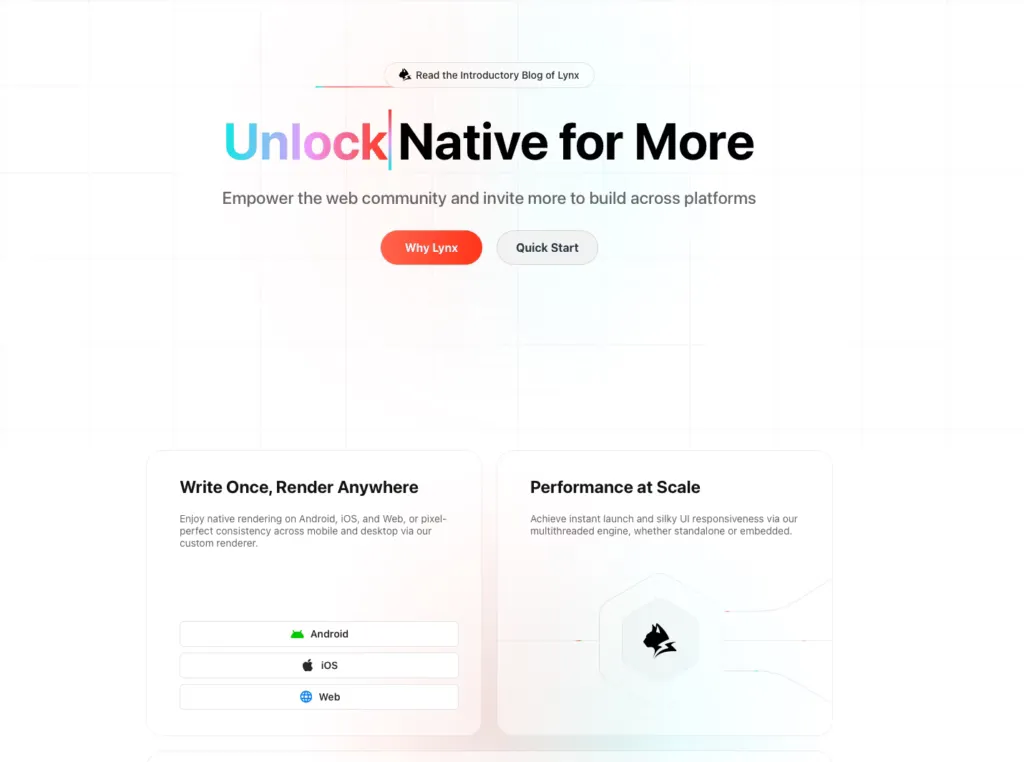 ByteDance’s Lynx: A Comprehensive Analysis of the New Cross-Platform Framework
Motivations Behind Lynx’s Development
ByteDance developed Lynx to address performance limitations in existing frameworks, particularly for high-traffic apps like TikTok. Internal testing revealed that React Native and Flutter struggled with:
- First-frame latency: Blank screens during app startup degraded user experience.
- Main-thread contention: Heavy JavaScript computations caused UI stutter. Lynx’s architecture directly targets these issues, enabling TikTok’s engineering team to achieve native-like performance while maintaining a single codebase across mobile and web platforms.
Native Capabilities and Communication
Native Module Integration
Lynx supports native module development through a binding layer that bridges JavaScript and platform-specific code (Swift/Kotlin). For example, a geolocation module would expose native APIs to JavaScript via Lynx’s interop interface, similar to React Native’s NativeModules but with reduced overhead due to the dual-thread design.
Rendering Engine
The framework’s rendering engine compiles Lynx components (e.g., <View>, <Text>) into platform-native elements. Unlike React Native’s Yoga layout engine, Lynx uses a multithreaded interactivity model that prioritizes rendering over business logic, ensuring smoother scrolls and transitions.
Performance Benchmarks
Early adopters report significant improvements over React Native:
- Startup Time: Lynx apps launch 40–60% faster due to IFR.
- Memory Usage: PrimJS’s efficient garbage collection reduces memory consumption by 30% compared to Hermes.
- UI Responsiveness: Touch latency in Lynx is <100ms, matching native iOS/Android benchmarks, while React Native averages 150–200ms under load.
Getting Started with Lynx
Prerequisites
- Install Rust and Node.js.
- Set up platform-specific toolchains (Xcode for iOS, Android Studio for Android).
Project Initialization
npx @lynx-js/cli create my-app
cd my-app
npm install
npm run dev
The CLI generates a starter template with TypeScript, ReactLynx, and platform configurations. The Lynx Explorer app (available on iOS/Android) enables live previews during development.
Platform-Specific Challenges
Windows users may encounter setup issues due to limited toolchain support, whereas macOS offers a smoother experience.
Early Adopters and Use Cases
Lynx already powers critical components of TikTok, including:
- Search and Discovery: High-performance rendering of dynamic content feeds.
- TikTok Studio: A content management tool requiring complex UI interactions.
ByteDance’s internal adoption validates Lynx’s scalability, though third-party ecosystem maturity lags behind React Native. Lynx represents a paradigm shift in cross-platform development, combining web developer familiarity with native performance. Its dual-thread architecture and CSS-centric styling make it particularly appealing for animation-heavy apps, though the nascent ecosystem may deter enterprises reliant on React Native’s mature tooling. As ByteDance invests in community growth, Lynx could emerge as a formidable React Native alternative, pushing the entire industry toward more performant, framework-agnostic solutions. For developers, the choice between Lynx and React Native hinges on project requirements: Lynx for performance-critical apps with web-style workflows, and React Native for ecosystem-rich projects prioritizing rapid iteration. Either way, Lynx’s arrival signals a vibrant future for cross-platform innovation.
Liked this insight?
Share it with your colleagues and network.
Frequently Asked Questions
What is ByteDance Lynx and when was it launched?
Lynx is an open-source cross-platform framework from ByteDance, launched on March 5, 2025, enabling high-performance apps for Android, iOS, and web with a single codebase.
How does Lynx differ from React Native?
Lynx combines web development paradigms with native performance, using a multi-threaded architecture and a custom rendering engine, whereas React Native relies on a JavaScript bridge and native modules.
Is Lynx production-ready for enterprise applications?
As of its March 2025 launch, Lynx is early-stage open-source; enterprises should evaluate maturity, community support, and ecosystem before adopting for critical production workloads.