
Effective 1-on-1s: How to Run 1-on-1s That Actually Matter
On This Page
Executive Summary / TL;DR
Effective 1-on-1s prioritize the human, not status updates; use the 10/10/10 framework (them, you, future) and fiercely protect this time.
Key Takeaways
- Shift 1‑on‑1 focus from task updates to personal goals and motivations.
- Apply the 10/10/10 structure: listen, growth feedback, future vision.
- Change the setting – walk or meet off‑screen to lower hierarchy.
- Use a shared 1‑on‑1 “Compass” doc for prep, notes, and follow‑up.
- Ask open coaching questions and speak less than 40% of the time.
Your 1-on-1s Are Probably Status Updates in Disguise
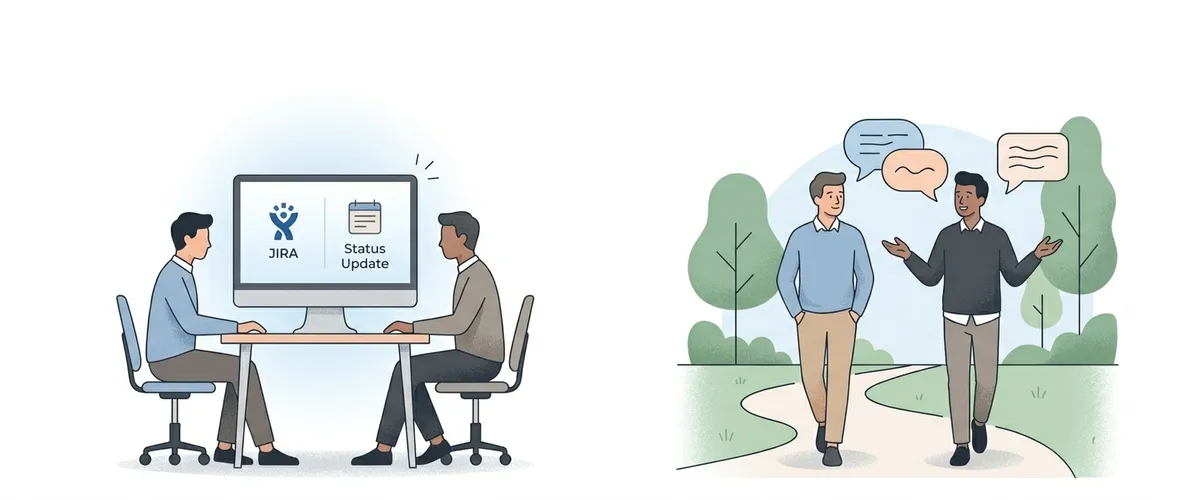
Early in my management career, I had a template. Thirty minutes, every two weeks. I'd open my Jira board, they'd walk me through their tickets, I'd ask if they needed anything, they'd say no, and we'd wrap up in twenty minutes. I thought I was being a good manager. Efficient. Respectful of their time.
I was terrible at 1:1s and I didn't know it yet.
The signal I missed came slowly. One of my best engineers left for a competitor. Not for more money. For a manager who, as she put it in her exit conversation, "actually wanted to know me." That one sentence sat with me for a long time. I had regular 1:1s with her. We talked about the work constantly. But I never asked what she actually wanted from her career. I never asked what kind of engineer she was trying to become, or what was draining her, or where her curiosity was pointing.
I didn't lose an engineer. I lost a relationship I never really built.
That was the beginning of me rethinking everything.
The Real Problem: We're Running Mini Stand-Ups With One Person
Most engineering managers run 1:1s like they're a stand-up with a smaller audience. Ticket progress. Sprint blockers. Risk items. "How are you doing?" asked in a tone that doesn't invite a real answer.
None of that is wrong exactly. But it's not what makes a 1:1 valuable.
The problem is we optimize for things that feel productive: information flow, clarity on work, visibility on risks. These things matter. They just don't belong in your 1:1. They belong in your team meetings, your sprint reviews, your async updates.
The 1:1 is for something harder to schedule: knowing the person sitting across from you.
That's an uncomfortable reframe if you came up through engineering, like I did. We're trained to solve problems, move things forward, give answers. A good 1:1 requires you to resist all of that. Sometimes the whole point is to sit with a question you don't know the answer to.
Get Out of the Room
The first thing I changed was the most visible: I stopped doing 1:1s at a desk.
I started walking. Or sitting in the café downstairs with coffee. Sometimes on a park bench near the office, or in an open lounge that wasn't laid out like a meeting room. No laptop. No screen between us. Just two people talking.
The signal this sends is subtle but real. When you sit across from someone with a monitor between you, the screen becomes a third participant. It pulls your attention. It invites you to pull up dashboards, share a doc, jump to the ticket board. The frame becomes "let's look at things together" instead of "let's talk."
Walking, specifically, does something useful. Research on this is consistent: side-by-side movement reduces the social pressure of direct eye contact and increases the kind of thinking that's more open-ended and exploratory. There's a reason some of the most honest conversations you've had in your life happened while walking somewhere. Phil Jackson, who coached six NBA championship teams with the Chicago Bulls, talked at length about creating rituals and spaces where players felt safe enough to be honest. The physical environment was never incidental to him. It was part of the work.
I don't think you need to be religious about it. Some people prefer a table. Some need more structure. But I'd push you to try at least one walking 1:1 a month and pay attention to what surfaces that doesn't surface in a room.
The bigger point: be intentional about the environment. Don't take these meetings in open spaces where your engineer feels watched. Don't do them at your desk where Slack is one glance away. Where you meet says something about how much you think this time matters.
Know the Whole Person
Over time I've started thinking about getting to know someone across three layers. I try to stay genuinely curious about all three, and I come back to them across dozens of conversations.
Who they are as a person. What do they care about outside of work? What makes them feel energized versus completely drained? What are they afraid of? What's their relationship with failure? You're not trying to be their therapist. You're trying to understand the full human being who shows up on your team every day. This is the foundation everything else sits on.
What they're capable of as an engineer. Not just their current title or their assigned work, but their range. What are they genuinely excellent at? What are they growing toward? Where is the gap between how they see themselves and how the team sees them? This takes time because most engineers undersell themselves in ways that become invisible unless you look for them.
What they believe in. How do they think good engineering should work? What frustrates them about the way most companies operate? What kind of engineer are they trying to be over a ten-year horizon? This is where you find out whether they're pointed in the same direction as the team, and it's where you find out what actually motivates them underneath the surface.
I've had engineers on my team who, once I understood their beliefs, I could see were completely misaligned with the system we were working in. Some of them I could help find better conditions. Some I couldn't. But knowing their beliefs meant I wasn't surprised. And it meant I could have honest conversations instead of just watching things quietly deteriorate.
This knowledge doesn't come from a single conversation. It comes from dozens of small moments across months. But you have to go after it deliberately. It will not surface in a status update.
The 10/10/10 Framework
Once I had a clearer sense of what a 1:1 was actually for, I needed a way to run the time without it drifting. Here's the framework I settled on. I call it 10/10/10.
This isn't something I invented. Versions of it exist in executive coaching and leadership development literature that has nothing to do with engineering. I've adapted it for how I run technical teams, but the logic comes from outside our world, and I think that's part of why it works.
The first 10 minutes belong to them. No agenda from me. I open with something like "what's on your mind?" and I don't redirect it. If they want to talk about the sprint, fine. If they want to talk about something personal, I stay with that. This time is for whatever is heaviest for them right now. My job is to listen more than I speak.
The second 10 minutes are for the work in the broader sense. Career growth. Feedback. Skills they're building. Things I'm observing. Anything I need them to hear. But the framing is always forward-looking, not a report card. Not "here's what I noticed" delivered as a verdict, but "here's something I want to think through with you."
The third 10 minutes are for the future. Where do they want to be? What do they wish they were working on? What's the thing they're most curious about professionally that they're not getting to explore? This is the section that gets dropped first when managers get busy. Don't drop it. This is where the real development work happens. Career conversations are easy to deprioritize until someone hands you their resignation, and by then it's too late.
The 10/10/10 isn't a rigid timer. I'm not watching a clock. But it keeps me from spending twenty-five minutes on sprint topics and then checking the box on "1:1 done."
Ask Questions That Make Them Think, Not Just Answer
I read Michael Bungay Stanier's book "The Coaching Habit" a few years ago and it changed something in how I run these meetings. The central idea is that most managers are addicted to advice. The moment someone describes a problem, we jump to solutions. We want to help. But advice often takes away the other person's chance to figure things out themselves, and over time it builds dependency. People stop reasoning through problems because they've learned the manager will reason for them.
The better move is almost always a question.
Not a leading question with your answer hidden inside it. A real question, one where you don't already know the answer and you're genuinely curious.
Some questions I come back to often:
- "What's the real challenge here for you?" (This one is from Stanier and it's almost startling how well it works. People will name a surface problem and this question will consistently surface the actual one.)
- "What have you already tried?"
- "What would you do if I wasn't here to ask?"
- "What does success look like to you on this, not to the team or the company?"
- "What's the thing you're not saying?"
- "What would have to be true for this to work?"
- "When you imagine yourself two years from now doing work you love, what does that look like?"
The Socratic method is thousands of years old for a reason. People change when they arrive at something themselves. Your job in a 1:1 is not to be the smartest person in the room. Your job is to ask the question that opens the door to the answer they already have but haven't found yet.
I have a personal rule: if I'm talking more than 40% of the time in a 1:1, I'm doing something wrong.
One more thing. Being curious about someone's ambitions is only half the work. The other half is helping them actually move toward those ambitions. That means creating real paths: giving them the project that stretches them, advocating for them in rooms they're not in, making introductions. But none of that is possible if you don't know what they're after. The questions come first.
Raising Signals Before They Become Problems
Here's the part nobody teaches you well.
There's a gap in most engineering organizations between "everything is fine" and "you're on a formal improvement plan." That gap is where trust breaks down. People feel blindsided when formal processes begin because nobody told them clearly, in plain language, that there was a problem building.
I use 1:1s to close that gap.
I think about it as Green, Amber, Red. Most of the time, things are green. When I start noticing patterns that concern me, I name them in the 1:1, informally, before they reach the level of a formal conversation. The goal is that by the time I ever need to have a formal performance conversation, the person has heard the signal at least twice in casual settings first. Nothing should be a surprise.
What this looks like in practice:
"Hey, I want to share something I've been noticing. Over the last month, I've seen a pattern where [specific situation and behavior], and the impact has been [concrete effect on the team or the work]. I don't know if you've seen this yourself, but I want to name it now while there's room to work with it. What's your read on it?"
That's it. No formal documentation. No HR language. Just an honest observation, named early, while there's still time to adjust.
A few things matter here.
Be specific, not general. "You seem checked out" is useless. "In the last three sprint reviews, you've left early twice and haven't asked any questions" gives someone something to work with.
Name the impact, not the intent. You don't know why someone is doing what they're doing. You know what effect it has. Stick to the effect. If you start speculating about intent, you'll be wrong half the time and you'll put someone on the defensive.
Make it a conversation, not a verdict. After you name the observation, stop talking. Ask what's going on. Ask if they've noticed it. Ask what might be driving it. Sometimes what looks like a performance problem is a motivation problem caused by something you're doing. Or it's a personal situation. Or it's that the work has stopped being interesting and nobody asked. You won't find out unless you ask.
The SBI framework from the Center for Creative Leadership is useful scaffolding here, even in informal conversations: describe the Situation, the specific Behavior you observed, and the Impact it had. That structure keeps you grounded in facts rather than drifting into interpretations.
Log it, even informally. After the conversation, write a brief note in your shared 1:1 doc. Not to build a paper trail in the defensive sense, but because clarity degrades. In three months, when you need to reference this conversation, you'll want to have it.
The 1:1 Compass: A Shared Doc Both of You Actually Use
The single biggest structural failure in most 1:1s is that there's no shared memory. The manager keeps notes somewhere. The engineer keeps notes somewhere else or nowhere. Conversations happen and dissolve. The good intentions formed at the end of one meeting are completely forgotten by the start of the next.
I use a shared Google Doc. I call it the 1:1 Compass. It's not complicated. Here's the template:
1:1 Compass Template
Copy this into a shared Google Doc. Both people have edit access. Write in it before the meeting, not during.
[Engineer Name] x [Manager Name] | 1:1 Compass
Last updated: [date]
This Week
- What's on your mind right now?
- Energy and morale this week (1 to 5, be honest)
- One thing going well
- One thing that's hard or frustrating
Your Growth
- What are you working toward in the next 3 to 6 months?
- What have you tried or explored since we last spoke?
- What do you need from me right now?
- What's a skill or area you're curious about that you haven't had room to explore?
Between Us
- Anything you've been sitting on that you want to raise?
- Is there anything I'm doing that's making your work harder?
Signals and Feedback
Both of us can write here. This is for early observations, positive and constructive, not formal performance notes.
[Running log, most recent at top]
Open Notes
[Running log of what we covered, what we committed to, what we want to return to. Most recent at top.]
The workflow is simple. Both parties write in the doc 24 hours before the meeting, not during it. If you write in it during the meeting, you spend the meeting writing instead of talking. If you write in it before, you spend the meeting on what actually needs to be discussed.
I ask my engineers to own "This Week," "Your Growth," and "Between Us." I own "Signals and Feedback." We both contribute to "Open Notes."
After every 1:1, I add one line to Open Notes: what we covered and anything we committed to. One line. It takes thirty seconds. Over six months, this becomes an incredibly useful record of a working relationship. It also gives you exactly what you need when it's time to write a performance review or make a promotion case.
The doc is also a signal in itself. When an engineer starts writing less in "This Week" or stops filling in "Your Growth," I pay attention to that. Something has shifted. That's often the moment to have a more direct conversation about where they are.
Fiercely Protect This Time
I've cancelled 1:1s when I shouldn't have. I've rescheduled repeatedly when I should have held the slot. Every time I did that, I sent a message, even when I didn't mean to: the work matters more than you do.
That's the wrong message.
My rule now is I reschedule, I don't cancel. And I reschedule within the same week, not to the next cycle. A bi-weekly 1:1 that keeps slipping to monthly isn't a 1:1 anymore. It's a quarterly check-in with less structure. The continuity is what makes these meetings matter. Relationships don't build in one-off conversations. They build through the pattern of showing up consistently.
When I started managing managers, one of the first things I told them was: if you cancel a 1:1 for an incident, the message you send is that incidents matter more than people. Sometimes that's unavoidable. But notice it. Name it to the person. And don't let it become a pattern.
The last thing I'll say on this: preparation matters. Walk into every 1:1 having read the doc your engineer wrote. Think for five minutes about what's been happening for them that week. Show up present, not coming directly from a context switch with your head still in the previous meeting. The preparation doesn't need to be long. It needs to exist.
What I Wish I Knew Earlier
I want to end with something that took me longer to figure out than it should have.
Your engineers are not resources. They're not headcount. They're not units of output on your team's capacity plan.
They're people with full lives, with ambitions that extend well beyond the current company, with fears that have nothing to do with their sprint velocity.
The best 1:1s I've ever had weren't the ones where I had the right framework or asked the perfect question. They were the ones where the person across from me felt, in some real way, that I cared about what happened to them. Not as a means to a better team performance. Not to improve my retention numbers. Actually cared, the way you care about someone when you've been paying attention to them over time.
That's not something a framework gives you. It's something you build by showing up, asking real questions, listening well, and not letting the calendar pressure you into a status update when someone needed a real conversation.
The 1:1 is thirty minutes, every two weeks. That's twenty-six hours a year with each person on your team.
Make it count.
I write about engineering leadership, team building, and the things I've gotten wrong along the way at rutvikbhatt.com.
Liked this insight?
Share it with your colleagues and network.
Frequently Asked Questions
Why are traditional status‑update 1‑on‑1s ineffective for engineer retention?
They focus on tasks instead of the person, missing motivation, career goals, and personal challenges that drive engagement and loyalty.
How does the 10/10/10 framework structure a productive 1‑on‑1?
First 10 minutes: listen to what’s on their mind; second 10 minutes: discuss growth, feedback, and skills; third 10 minutes: explore future aspirations and next steps.
What practical steps can I take to make my 1‑on‑1 environment more conversational?
Meet off‑screen – walk, sit in a café, or use a lounge; remove laptops; use a shared doc for prep; and ask open, coaching‑style questions.