
What the Pareto Frontier Means for Engineering Leaders

On This Page
Executive Summary / TL;DR
A plain-language guide to the Pareto frontier, with engineering leadership trade-off examples and a practical guide for deciding what to defend and what to escalate.
Key Takeaways
- Check whether a trade-off is real before accepting it — most 'we can't have both' claims are process waste, not a true Pareto frontier.
- DORA research shows elite engineering teams achieve both higher deployment frequency and lower change failure rates at once, not one at the cost of the other.
- Identify which constraint is actually binding before assigning engineering effort to a metric — network distance and device hardware can cap the benefit of backend latency work in some markets.
- When a global target like p99 latency hits a hard constraint in one segment, redirect effort to a different lever (edge presence, lighter payloads) instead of pushing the same axis further.
- Defend a trade-off to leadership by naming the specific constraint behind it; escalate it when closing the gap would require new investment rather than more effort from the existing team.
Every planning meeting has a version of this argument. Someone wants more speed. Someone else wants more stability, or more revenue impact, or a higher hiring bar. The conversation ends the same way: we can’t have both.
Sometimes that’s true. Most of the time it isn’t, and there’s a simple way to tell the difference.
What a Pareto frontier actually is
A Pareto frontier is the line between improvements you get for free and improvements that cost you something else. Below the line, you can still get better at one thing without giving up the other. On the line, every extra gain on one side costs you on the other. Most teams treat every trade-off as if they’re already on the line. Usually they’re still below it, with room to improve for free.
The name comes from Vilfredo Pareto, an Italian economist. In 1906 he noticed that a small share of people in Italy owned most of the land, which later turned into the popularized “80/20 rule”. That’s not what we’re talking about here. The idea we want is a separate concept Pareto introduced: Pareto efficiency, where an outcome is optimal only when you can’t make one metric better without making another worse. Plot every possible allocation across two competing goals, and the most efficient states sit on a curve where nothing spare is left on the table. That curve is the Pareto frontier. Model makers and system designers use the same idea now, plotting a model’s accuracy against inference cost or latency — a breakthrough that beats prior baselines on both counts didn’t just optimize within trade-offs, it pushed the frontier itself outward.
Speed and stability: when the trade-off isn’t real
The same dynamic shows up across engineering leadership priorities: delivery velocity and system reliability, product experimentation and architectural purity, team hiring bars and time-to-hire. The universal mistake is assuming you’re already operating on the frontier before verifying your constraints.
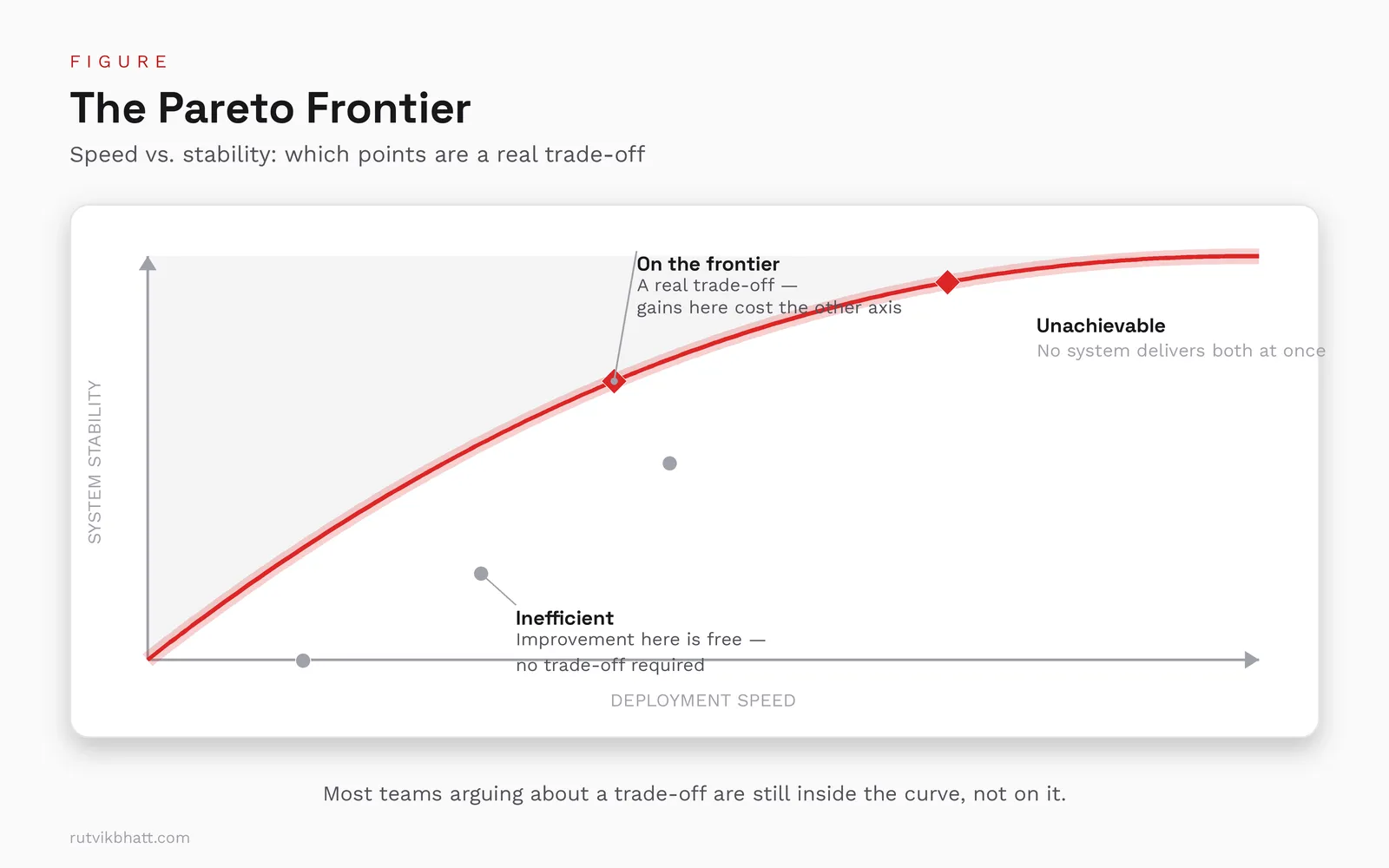
Take speed and stability, since every engineering manager has had this fight. It feels intuitive that shipping faster inevitably leads to breaking more things in production. Yet Google’s DORA research and the findings detailed in Accelerate demonstrate the exact opposite at the top of the performance distribution: elite engineering teams achieve both significantly higher deployment frequency and lower change failure rates simultaneously. Speed and stability move together for high-performing organizations because teams debating the trade-off are usually operating far below the frontier — bogged down by bloated batch sizes, brittle CI pipelines, and bureaucratic approval gates. When you strip away process waste and refine team workflows, both metrics improve in tandem because the supposed trade-off was never a hard constraint to begin with.
When you’re optimizing the wrong axis
Setting a latency target across markets makes the same point in a more concrete way.
Say the team establishes a strict p99 latency target under 200 milliseconds everywhere the product operates. Managing high-percentile tail latency — famously analyzed in Jeffrey Dean and Luiz André Barroso’s paper The Tail at Scale — usually starts as a software engineering problem: tune database indexing, leverage strategic caching and data distribution, and collapse redundant RPC round trips. In mature markets, every one of those changes represents meaningful progress, moving the team toward the true frontier.
One emerging market keeps missing the target no matter how much backend optimization goes into it. Look closer and the backend isn’t the binding constraint anymore. Users sit thousands of kilometers from the nearest data center, so the speed of light over fiber swallows a major chunk of the request budget. Regional cellular networks introduce high packet loss and packet retransmissions before a request ever hits your gateway. Furthermore, the local fleet of low-tier client devices struggles with JavaScript execution; even if the payload arrives in 150ms, the main thread freezes for 600ms just parsing and hydrating the DOM. The device CPU and memory are the real bottlenecks, not server processing.
At that point, pouring additional engineering bandwidth into server micro-optimizations yields zero perceptible user experience gains. The constraint shifted outside the domain of the backend service. That’s engineering bandwidth spent past the point where it does any good, which is a different failure than the one it looks like on a dashboard.
The effective move is recognizing that the frontier for that segment isn’t server latency at all. It’s geographic transit and client hardware limitations. The levers that actually shift the frontier sit in edge computing and CDN points of presence to terminate TLS locally, coupled with radically leaner client payloads. Forcing an uncalibrated, blanket latency metric everywhere — without defining context-aware SLOs and SLAs — burns valuable engineering bandwidth in the one place that cannot move the needle.
A practical guide for raising this with leadership
Checking whether you’re actually on the frontier, before agreeing to a trade-off or funding an optimization, matters more than knowing the concept exists. That check has a shape you can repeat, and it changes what you say to leadership depending on what it finds.
Name the two axes and the real constraint
Before accepting or defending any “we can’t have both,” get specific about which two metrics are genuinely in tension and what fundamental mechanism creates that tension. Vague assertions like “speed versus stability” invite unproductive friction. In contrast, framing the tension around concrete variables — such as release batch size versus blast-radius recovery time — provides an actionable baseline. When managing engineering priorities and stakeholder expectations, clarity on specific constraints prevents teams from defending an imaginary frontier they have never actually tested.
Check for free wins before calling it a trade-off
Look for operational friction first: ceremonial approval meetings that catch no defects, redundant CI steps, or arbitrary targets applied uniformly across disparate architectures. If eliminating that overhead improves both dimensions at once, there was no zero-sum trade-off to negotiate. It doesn’t belong in an escalation with leadership; it belongs on your team’s internal backlog as technical hygiene.
If the trade-off is real, explain the mechanism, not just the number
A trade-off that genuinely sits on the frontier can be articulated causally, the way the emerging-market latency example does. Name the physical, mathematical, or organizational boundary, explain why incremental effort along that axis yields diminishing returns, and clarify what the team is consciously protecting instead. When navigating senior leadership feedback on complex technical decisions, explaining the underlying trade-off mechanics transforms what might sound like defensive pushback into an objective architectural dialogue. This is the case where staying under the curve is the right call, and it’s worth saying so plainly rather than apologizing for it.
Escalate when the ask sits above the frontier
Some requests cannot be met by simply shifting effort along your current curve. They demand an outcome that the existing system and team structure are mathematically incapable of delivering without structural investment: modernizing build tooling, restructuring to autonomous domains, adding infrastructure footprint, or expanding headcount. When that happens, avoid quietly absorbing unrealistic targets as overtime. Clearly delineate what it takes to shift the Pareto frontier outward, estimate the necessary capital and operational investment, and let executive leadership make an informed strategic decision. That turns “we can’t have both” into a real decision instead of a stalemate, and redirects bandwidth before it’s spent on a metric nobody downstream is waiting on.
Liked this insight?
Share it with your colleagues and network.
Frequently Asked Questions
What is a Pareto frontier?
A Pareto frontier is the boundary of outcomes where you can't improve one goal without making another one worse. Outcomes below the frontier can still improve on one metric without sacrificing the other, at no real cost.
How is the Pareto frontier different from the 80/20 rule?
Both come from Vilfredo Pareto, but they're different ideas. The 80/20 rule describes how a small share of causes produce most of the effects. The Pareto frontier describes the boundary of efficient trade-offs between two or more competing goals.
How is the Pareto frontier useful in engineering leadership or management?
It provides a framework to distinguish between genuine constraints and operational waste. Instead of accepting vague 'we can't have both' compromises, leaders can identify when teams are operating below the curve (where process refinement yields free wins) versus on the curve (where gains require conscious trade-offs or structural capital investment).
Are speed and stability always a trade-off in engineering teams?
No. DORA research shows elite teams achieve both high deployment frequency and low change failure rates at once, because most teams treating it as a trade-off are still carrying process waste rather than sitting on the true frontier.
Why does optimizing backend latency sometimes fail to improve the user experience?
Once network distance and device hardware become the binding constraint, further backend latency work can't be felt by the user. The bottleneck has moved outside the axis being optimized, so continued backend investment there stops paying off.
How should an engineering manager decide whether to defend a trade-off or escalate it to leadership?
Defend it when you can explain the specific constraint causing it, which means the team is genuinely on the frontier. Escalate it when closing the gap would require real investment, like new tooling or headcount, rather than more effort from the current team.